
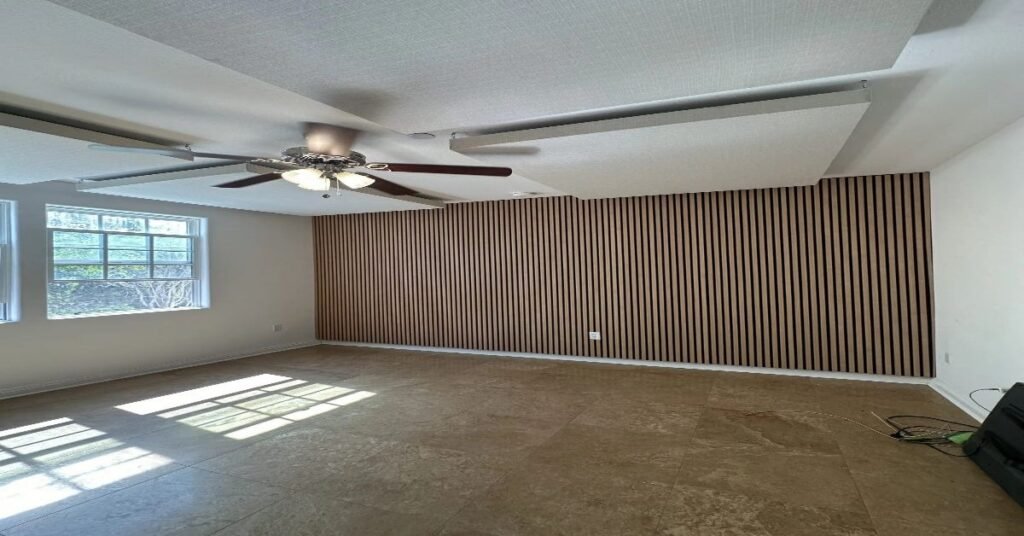
Step into a busy restaurant, church, or an open office setting and chances are high that you will experience a similar challenge. You can hear everything, but you will not be able to make much sense of it. Sound will be bouncing off solid surfaces such as glass, concrete, drywall, etc., even after the original sound has ceased. What you get is echo, distortion of speech, and a tiring sound environment. Rugs and curtains will hardly help you. Acoustic wood panels represent a more effective solution that will help you manage your sound and finish your walls nicely at the same time. This article provides information on sound behavior and acoustic wood panels’ function. It is useful to know both.
Why Rooms Echo
Sound travels through space in the form of waves. Upon hitting a hard and flat surface, sound energy will be reflected back into the room. The more hard surfaces your room has, the more waves will come together, forming reverberation. A bedroom and a sanctuary are just two examples of the spaces that have to fight this physical phenomenon on different scales.
How Do Wood-Finished Panels Decrease Echo?
In panels, sound is absorbed because the sound energy inside them is trapped in the dense core of the panel. Through internal friction within the material, the trapped sound energy dissipates as heat, significantly reducing the amount of sound reflected back into the space..
The wood finish gives another advantage to the panels – they become aesthetically pleasing when finished in wood. In offices, dining establishments, and houses where looks matter just as much as the acoustics, the panels will fit into the design of the room naturally.
Panels, Bass Traps, and Diffusers
Panels are one of the many tools used for sound treatment. The panels absorb mid to high frequencies, covering most sounds made by people and musical instruments. Bass traps are located in corners and absorb low frequencies, which acoustic panels do not cover. Diffusers scatter sound in all directions. Large rooms generally require a combination of all three.
Where Acoustic Treatment Makes a Difference
Reflection occurs in many settings, including.
- Offices and meeting rooms, where people have to project their voice
- Restaurants, where noise causes customers to yell
- Churches and schools, where clear speaking is important
- Home theater and studio, where accuracy is critical
Customized Products from Evolve Acoustics
Evolve Acoustics was founded by music producer and acoustical consultant, Avi E Marmer, and it provides customized acoustic panels, bass traps, and diffusers for homes, offices, restaurants, schools, churches, and studios. In addition, the company’s team provides consultations, design, and room sound measurement services so that the products will match the size and use of the room. The company offers both fabric-wrapped and custom-framed products with a superior wood finish.
Tips on Planning Prior to Purchasing
Begin by doing the following: Firstly, identify the issue that needs to be solved – echo, unintelligibility, or sound leaking through the walls. Panels solve echo, while stopping the leaks requires soundproofing, which is a different service. Secondly, measure the room and make a list of the hard surfaces present in it. Finally, allocate a budget and get recommendations.
Conclusion
Acoustic panel installation is equally important as the panels themselves. The placement will determine whether an acoustic panel makes the room better or only serves as decoration. Installation is done in Southern California by Evolve’s team itself, hence reducing any disruptions in teaching, services, and working days. Begin with a consultation, specify the problem, and get the recommended size of acoustic panels.